
See our Ducted Air Conditioning cost guide →
Ducted Air Conditioning
Australia's vetted network of licensed ducted air conditioning installers. Get free quotes from insured, refrigeration-licensed specialists.
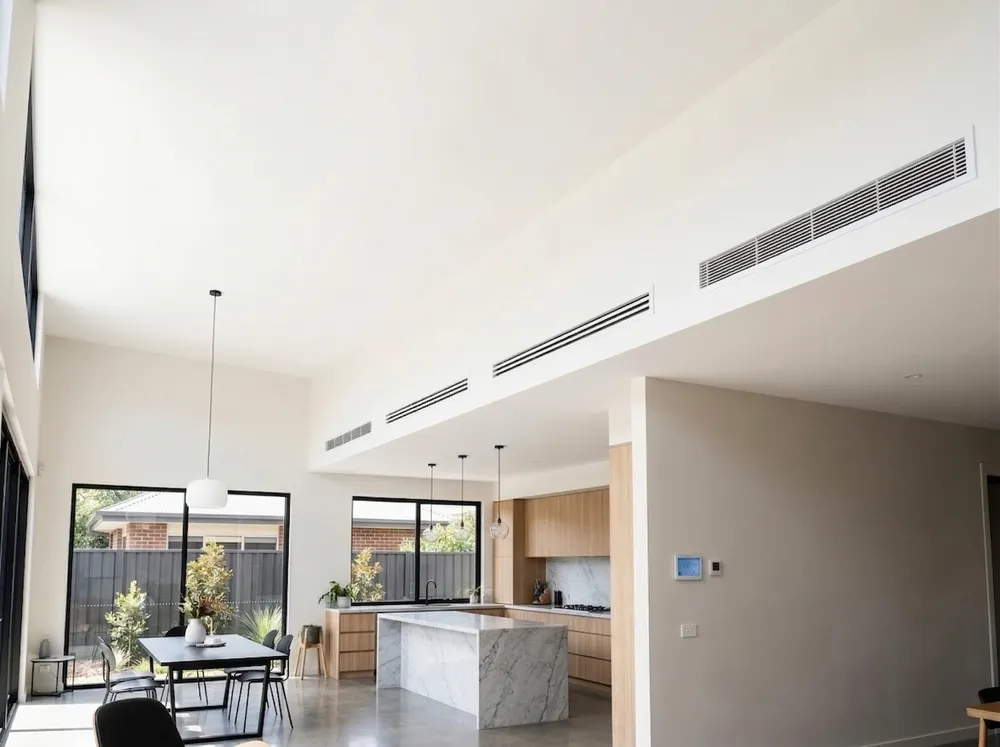
Professional Ducted Air Conditioning Installation Across Australia
Ducted reverse-cycle air conditioning is the gold standard for whole-home comfort in the Australian climate. A single outdoor unit connects to a central indoor unit in the roof space, pushing conditioned air through insulated ducts to every room. Done right, a zoned ducted system gives you room-by-room control, near-silent operation, and energy efficiency that split systems cannot match at scale. Getting the system sized correctly — not just for the total floor area, but accounting for ceiling height, insulation, glazing, and orientation — is what separates a system that performs from one that runs constantly and still falls short.
Why use a licensed ducted AC installer?
- ARCtick refrigerant handling licence required by law for all ducted system work
- Correct kW sizing based on room-by-room heat load calculation, not floor area alone
- Duct design and layout balanced for even airflow to all zones
- Roof space assessment for structural clearance, insulation depth, and condensate drainage
- Electrical work (dedicated circuit, isolator) must be done by a licensed electrician
Zoning — the feature that pays for itself
A zoned system lets you condition only the rooms in use — bedrooms at night, living areas during the day. Modern zone controllers pair with smartphone apps and can integrate with solar inverters to run the system during peak generation hours. A good installer will map zones against how your household actually uses the home, not just draw lines on a floor plan.
Frequently asked questions
Fully installed ducted reverse-cycle systems typically cost between $7,000 and $25,000+ depending on system capacity, number of zones, roof space complexity, and brand. A 10–12 kW system for a three-bedroom home with four zones generally falls in the $10,000–$15,000 range. Larger homes, slab construction (requiring under-floor ducting), or double-storey layouts push costs higher. Always get at least two itemised quotes covering the unit, ducting, electrical, and zoning controller separately.
Sizing is calculated from a room-by-room heat load assessment — not a simple floor-area rule of thumb. A 200 m² home with good insulation in Melbourne needs a very different system to the same footprint in Brisbane or Darwin. Key inputs are ceiling height, glazing area and orientation, wall and ceiling insulation ratings, and typical occupancy patterns. An undersized system never reaches setpoint; an oversized system short-cycles and wears out faster.
Yes, and it is one of the most common installs. The main constraint is roof space: you need enough clearance for the indoor unit and duct runs, and the structural members need to accommodate penetrations. Slab-on-ground homes without roof space can use under-floor ducting if there is a subfloor void. Your installer will inspect the roof space before quoting — don't accept a quote from anyone who skips this step.
Daikin, Mitsubishi Electric, Fujitsu, and Actron Air are the most widely installed ducted brands in Australia and all have strong service networks and spare-parts availability. Panasonic and LG are solid alternatives. Brand matters less than correct sizing and installation quality — a premium brand installed poorly will underperform a mid-range brand installed correctly. Ask your installer what brands they are authorised to service as well as sell.