
See our EV Charger Installation cost guide →
EV Charger Installation
Australia's vetted network of licensed electricians specialising in home and workplace EV charging. Get free quotes from insured installers.
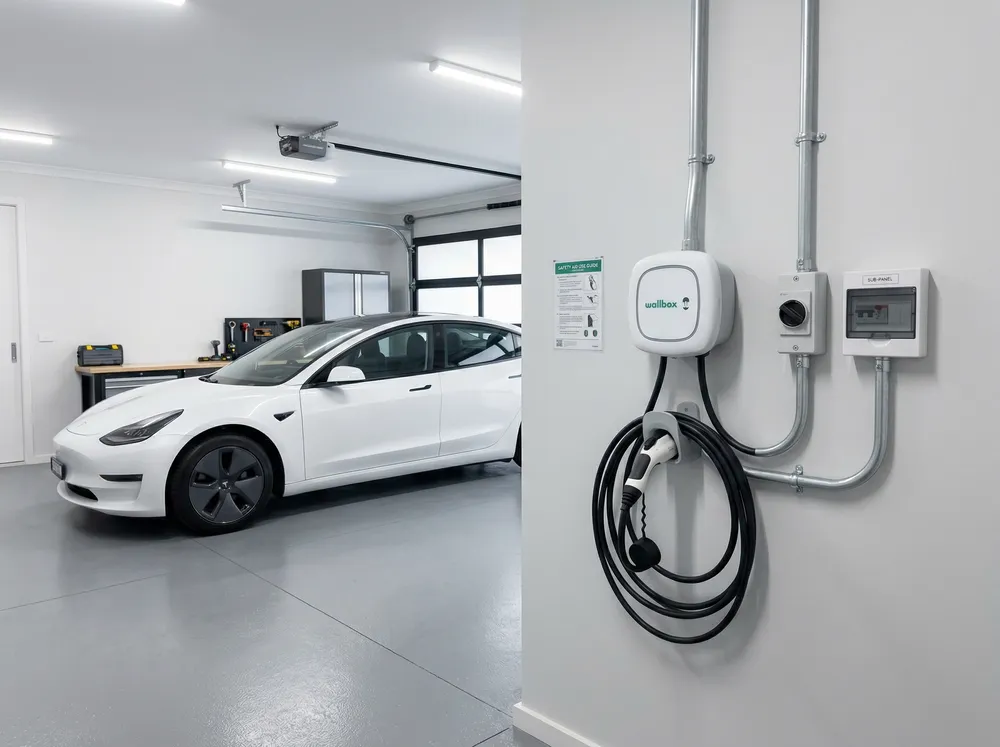
Professional EV Charger Installation Across Australia
A dedicated wall charger charges your EV faster and more safely than a standard power point. Correct installation means checking your switchboard capacity, cable sizing for the run to your parking spot, RCD protection, and — where needed — load management so charging does not overload your mains supply.
Why use a licensed electrician?
- Legal requirement: fixed EV circuits must be installed by a licensed electrician
- Correct circuit breaker and cable size for your chosen charger kW rating
- Compliance with AS/NZS 3000 and manufacturer warranty conditions
- Load management options if your mains supply is near capacity
- Certificate of electrical safety for insurance and property records
Typical home setups
Most Australian homes install a 7 kW single-phase wallbox (32 A), which adds roughly 40–50 km of range per hour on typical EVs. Three-phase homes can support 11–22 kW units for faster charging. Tethered units include the cable; socket-only units let you use your own Type 2 lead. Your installer will confirm what your switchboard and supply agreement allow.
Frequently asked questions
Expect roughly $1,000 to $2,500 installed for a standard 7 kW wallbox on a single-phase home with a short cable run from the switchboard. Longer trenching, switchboard upgrades, or three-phase work increases cost. The charger hardware itself ranges from about $800 to $2,500 depending on brand and smart features.
Many EVs include a portable granny charger for occasional top-ups, but it is slow (often 2 kW or less) and not ideal as a daily solution. A dedicated wall charger is faster, safer on a permanent circuit, and better for battery health over years of daily use.
No. Most homes charge fine on single-phase 7 kW. Three-phase is optional if you want 11–22 kW charging or have multiple EVs. Your electrician will check your incoming supply and switchboard before quoting.
Get quotes from Supertrades partners across Australia
Victoria
NSW
Queensland
Western Australia
South Australia
Tasmania
Northern Territory
ACT
Install EV chargers?
Homeowners across Australia are already requesting quotes for this work. Join the network and we'll email you job briefs for your area.
- Job briefs straight to your inbox
- Only jobs in the cities you cover
- Takes about 2 minutes to join