
See our Hydronic Heating cost guide →
Related: Underfloor Heating
Hydronic Heating: Compare Quotes from Local Installers
Planning hydronic heating for your home? Supertrades connects you with a vetted network of local professionals across Australia, so you can compare quotes for installation, servicing and repairs.
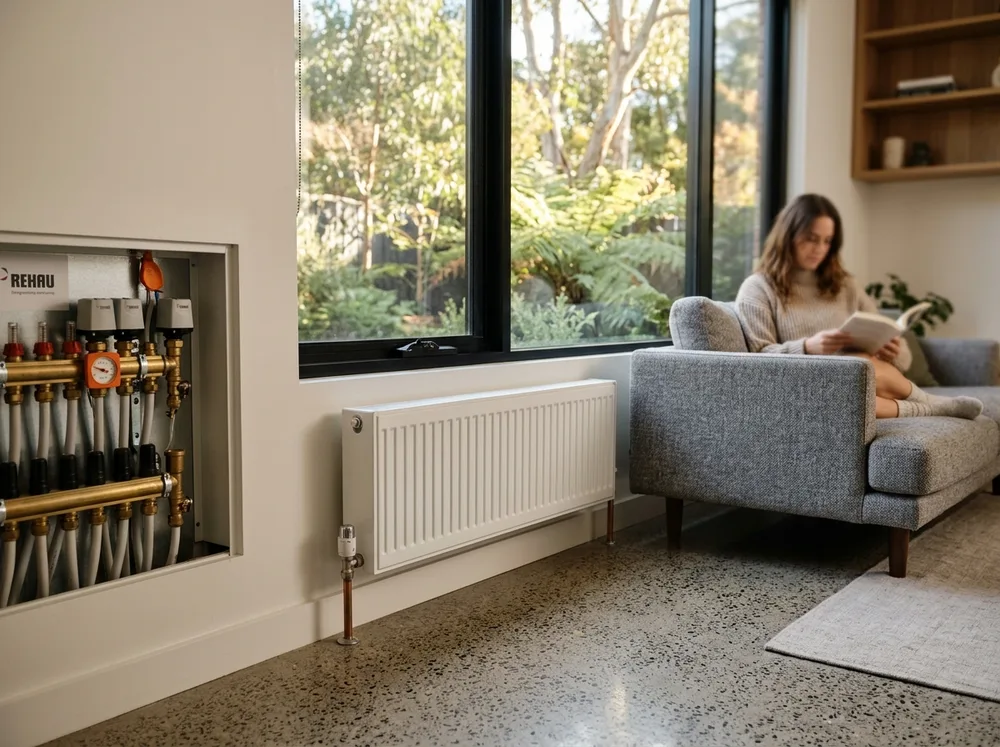
Find the right hydronic heating solution for your home
Hydronic heating circulates heated water through pipes to warm rooms through radiators, panels or underfloor systems. It can suit new builds, renovations and some existing homes, with options including a hydronic heating boiler or a heat pump for hydronic heating. The right setup depends on your home, energy supply, climate and budget.
Compare hydronic heating systems
A local installer can assess your property and explain which system may work best. Common options include radiator heating, hydronic panel heating and hydronic underfloor heating. Underfloor designs may be installed within a concrete slab or beneath the floor finish, depending on the building and project.
- Hydronic radiators and panels deliver heat into individual rooms and can be practical for retrofits.
- Hydronic floor heating distributes warmth across the floor, with installation requirements that vary by construction type.
- In-slab hydronic heating places pipework within a concrete slab and is generally considered during a new build or major renovation.
- A hydronic heating heat pump or boiler heats the water. Available choices can include gas and electric systems, depending on the property and local requirements.
- Hydronic heating towel rails can add warmth and help dry towels in bathrooms.
How does hydronic heating work?
A heat source warms water, which is circulated through a sealed pipe network to radiators, heating panels or underfloor loops. The system transfers warmth into rooms, then returns cooler water to be reheated. Controls and system design affect comfort, response time and energy use. Ask an installer how the proposed hydronic heating setup will work with your home and energy supply.
What affects hydronic heating prices?
Hydronic heating cost is the lines added together. Panel radiators are $1,200 to $1,800 each. A 3 bedroom home with 7 radiators, a gas condensing boiler and a single storey on stumps is $12,200 to $19,600. The same home with a heat pump is $18,400 to $30,600. In-slab pipework is $50 to $100 per square metre, for new builds only, and in-floor screed is $80 to $150 per square metre. Those rates do not include the heat source. A gas condensing boiler is $3,800 to $7,000. A heat pump is $10,000 to $18,000, and there is no current rebate for a hydronic heat pump. A 3 bedroom in-slab system with gas is $11,800 to $23,000. A 3 bedroom screed system with gas is $16,600 to $31,000. Double storey or slab access adds $2,000 to $5,000 on a radiator job. The smallest radiator job is $8,600 to $14,200. The largest radiator job is $27,600 to $46,400. The largest overall job, 5 or more bedrooms of screed with a heat pump, is $36,400 to $67,500. Yearly service is $250 to $350 and is not in those totals.
- The size, layout and insulation of your home
- The number of rooms and heating output required
- The heat source, such as a boiler or heat pump
- Whether you choose radiators, panels, underfloor or in-slab heating
- Access to pipework, floors and existing services
- Controls, zoning, removal of old equipment and any building work
- Local labour, site conditions and applicable standards
For a useful comparison, request itemised quotes that specify equipment, scope, controls, installation work and exclusions. A hydronic heating calculator or size calculator can provide an initial guide, but an on-site assessment is needed to confirm system sizing and installation costs.
Installation, servicing and repairs
Hydronic heating installation should be planned around the home’s heat loss, room layout and chosen heat source. Whether you need hydronic floor heating installation, panel radiators or a boiler replacement, compare the proposed design and inclusions before deciding. Ongoing hydronic heating servicing can help identify leaks, circulation issues or equipment problems. For repairs, share the system type and symptoms when requesting quotes.
- Describe your property, the rooms to be heated and any existing system.
- Explain whether you are considering radiators, panels, underfloor heating or a heat pump.
- Compare written quotes, including equipment, installation, warranty details and ongoing service requirements.
- Confirm who is responsible for relevant permits, compliance and any associated building work.
Get quotes from hydronic heating installers
Searching for hydronic heating near you, installers in NSW or a local hydronic heating service? Supertrades helps homeowners across Australia connect with local professionals and compare quotes for hydronic heating installation, servicing and repairs. Share your project details to get started.
Frequently asked questions
A hydronic heating system heats water and circulates it through pipes to radiators, panels or underfloor loops. A boiler or heat pump can provide the heat, while the system transfers warmth to the rooms in your home.
A typical hydronic heating install is the lines added together. A 3 bedroom home with panel radiators, a gas condensing boiler and a single storey on stumps is $12,200 to $19,600. Radiators are $1,200 to $1,800 each. The same home with a heat pump is $18,400 to $30,600. In-slab pipework on that home with gas is $11,800 to $23,000. In-floor screed with gas is $16,600 to $31,000. A gas condensing boiler is $3,800 to $7,000 and a heat pump is $10,000 to $18,000. The smallest job is $8,600 to $14,200. The largest is $36,400 to $67,500. Yearly service is $250 to $350 and is not in the total. A quote confirms the home and the pipe route.
The cheapest way depends on your home, energy tariffs, climate and how many rooms you need to heat. Using efficient heating in occupied rooms, improving draught sealing and insulation, and comparing running costs can help manage expenses. A local professional can advise on options for your property.
There is no single best hot water system for every Australian home. The right choice depends on household size, available energy sources, installation constraints, budget and hot water use. Compare system suitability, efficiency, warranties and installation requirements with a qualified professional.
There is no universally best hydronic boiler brand for every home. Suitability depends on system design, capacity, available fuel, local servicing support, warranty and compatibility with the rest of the installation. Ask installers to explain why a particular model suits your property.
Plumbers may recommend different water heaters depending on the household’s needs, energy supply, budget and site conditions. Ask for options that suit your usage and property, along with details about efficiency, installation costs, warranty and ongoing servicing.
There is no single No. 1 water heater brand for every household. Compare models based on your needs, energy source, efficiency, warranty, installer support and suitability for your home rather than relying on a general ranking.
Lifespan varies by model, water quality, installation, usage and maintenance, so no brand can be guaranteed to last the longest in every situation. Check the manufacturer’s warranty and servicing guidance, and ask an installer about expected life for suitable options.
You can compare products and pricing, but a qualified professional can help confirm the right capacity, system type and installation requirements. Ask for a written quote that clearly separates equipment, labour, warranties and any additional work.
Radiator heating can deliver warmth effectively when the system is properly designed and matched to the home. Efficiency depends on the heat source, controls, insulation, system condition and how the heating is used.
A radiator transfers heat from hot water or another heat source into the surrounding room. In a hydronic system, heated water flows through the radiator and returns to the heat source to be warmed again.
A gas hydronic system uses electricity for the pump and controls, and gas for the boiler. For about 160 square metres in Melbourne, gas hydronic heating is about $1,200 to $2,500 a year to run, and a hydronic heat pump is about $700 to $1,500 a year. Those figures depend on how many hours the heating is on. They are not part of the install total. Yearly service is a separate $250 to $350.
Get quotes from Supertrades partners across Australia
Victoria
NSW
Queensland
Western Australia
South Australia
Tasmania
Northern Territory
ACT
Install hydronic heating?
Homeowners across Australia are already requesting quotes for this work. Join the network and we'll email you job briefs for your area.
- Job briefs straight to your inbox
- Only jobs in the areas you cover
- Takes about 2 minutes to join